
Finished Basement Flood Cleanup in Arizona
Finished basement flood cleanup is harder than it looks from the top of the stairs. Every finish that makes the room nice to be in, the drywall, carpet, baseboard, built-ins, is also a layer that hides water and keeps air away from it. MH Restoration cleans up flooded finished basements across Arizona, and the whole job comes down to one skill: knowing what can be dried where it stands and what has to be opened.
Short answer
With clean water caught early, much of a finished basement can be saved: drywall dried through small holes behind the baseboard, carpet re-laid over new pad, solid cabinetry dried in place. With contaminated water or a late start, the lower walls and flooring come out. Readings and water category decide, not a blanket rule.
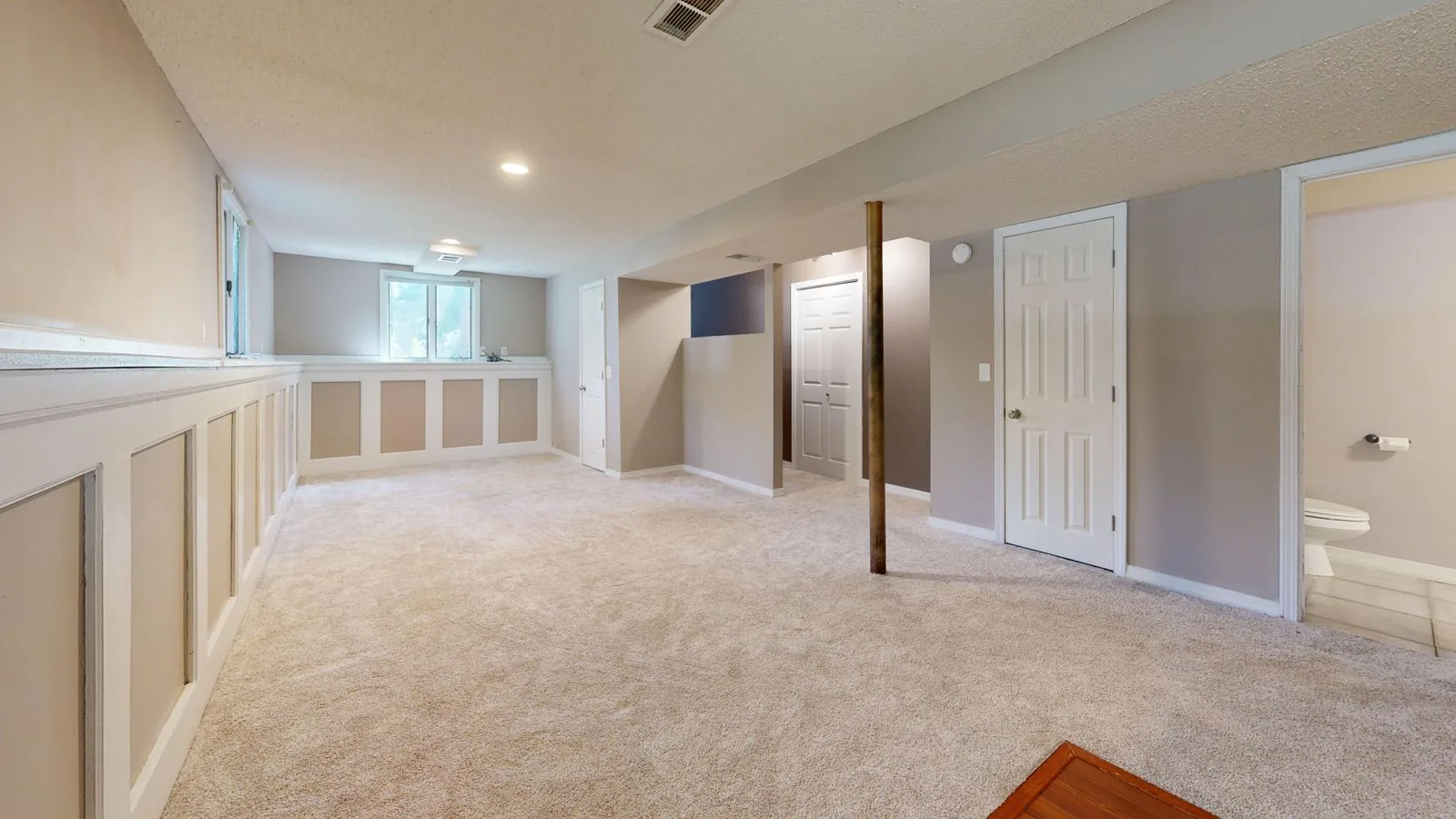
Why Finished Basements Are Different
- Layers. Paint over drywall over a vapor barrier over insulation over framing against concrete. Water gets into all of it and each layer slows the next from drying.
- Hidden spread. Water runs under walls on the slab. Three rooms can be wet behind the baseboards with only one showing a puddle.
- More to lose. Theaters, wet bars, gyms, guest suites. In Scottsdale and Paradise Valley we see wine rooms, custom millwork and stone.
- More decisions. Every material is a save-or-replace call, and each one affects cost.
What We Try to Save, and How
| Finish | How it's saved | When it can't be |
|---|---|---|
| Painted drywall | Baseboard removed, small holes drilled low, dry air pushed into the cavity | Sagging, swollen, contaminated, or wet insulation behind it |
| Wall insulation | Rarely. Rigid foam often survives; fiberglass batts don't once soaked | Most soaked batts |
| Carpet | Extracted, lifted, dried, cleaned, re-stretched over new pad | Sewage or storm water; delamination |
| Baseboard and trim | Solid wood: removed, dried, reinstalled | MDF swells and is replaced |
| Doors | Solid doors dry | Hollow-core doors that wicked water delaminate |
| Cabinets and built-ins | Toe-kicks removed, air directed underneath | Particleboard boxes that have swollen |
| Hardwood | Suction drying mats over days | Severe cupping, contaminated water |
| Tile | Dried in place | Tiles that have debonded |
| Drop ceiling tiles | No; they're cheap and stain | Any that got wet |
Flooring has its own page: basement carpet and flooring water damage.
How high does the drywall get cut?
Above the highest wet reading, not floor to ceiling and not an arbitrary line. Drywall wicks water upward, so the cut is usually set a foot or so above where the meter stops reading wet, commonly at two feet or four feet because that matches sheet dimensions and makes the repair cleaner. If someone proposes gutting to the ceiling for two inches of clean water, ask to see the readings.
Finished vs. Unfinished Basement Flood Cleanup
| Finished basement | Unfinished basement | |
|---|---|---|
| Finding the water | Needs meters, thermal imaging and test openings | Mostly visible |
| Materials at risk | Drywall, insulation, flooring, trim, cabinetry, furnishings | Stored contents, bottom of framing, mechanical equipment |
| Demolition | Often some | Rarely any |
| Drying | Slower; cavities and layers | Faster; open concrete and framing |
| Rebuild | Drywall, paint, flooring, trim | Usually none |
| Where it lands in the $3,000–$12,000 range | Middle to upper | Lower |
Unfinished basement flood cleanup still matters
Bare concrete looks like it can't be hurt, and that's where people get caught out. The slab and block walls absorb water and release it for days. The furnace, water heater and electrical panel are usually down there. Cardboard boxes on the floor grow mold in a week. And if you plan to finish the space later, trapped moisture in the slab will ruin the new floor. An unfinished basement still needs extraction, cleaning, drying and a look at the mechanicals. It just needs less of everything.
The Process in a Finished Space
- Safety, source, category
Power off, water stopped, clean or contaminated established. - Contents
Furniture blocked up or moved out; electronics and valuables first. - Extraction
See basement water removal. - Full moisture map
Every wall in every room on the level, both sides. This is where finished basements differ most. - Save-or-remove decisions, in writing
You see what's coming out and why before it's cut. - Selective removal
Baseboards off, wet pad out, flood cuts where needed, toe-kicks opened. - Drying with cavity systems
See basement drying. - Verification, then rebuild
Final readings, then insulation, drywall, texture match, paint, trim and flooring.
Insurance and a Finished Basement
For sudden plumbing failures, a homeowners policy commonly covers finished-basement repairs like any other room. For outside floodwater, it's a different picture: an NFIP flood policy generally does not cover finished basement walls, floors, ceilings or most contents, only structural elements and essential equipment. Owners of high-finish lower levels in flood-prone spots should ask an agent about private flood coverage with broader basement terms.
Most basement flood projects in Arizona cost $3,000 to $12,000 for cleanup and drying. A large, fully finished basement with contaminated water can exceed that, and reconstruction is quoted on top.
Rebuilding So the Next Flood Costs Less
- Mold-resistant or paperless drywall on the bottom four feet, held a half inch off the slab.
- Rigid foam against foundation walls in place of fiberglass batts.
- PVC or solid-wood baseboard instead of MDF.
- Tile, sealed concrete or click-together vinyl plank instead of laminate or glued carpet.
- Cabinets on legs or with plywood boxes.
- Leak sensors at the water heater, bar sink, bathroom and ejector pit.
- Covers and working drains on every window well.
Finished Basement Flood FAQs
Does a flooded finished basement have to be gutted?
Usually not. With clean water and a prompt start, drywall, carpet and cabinetry can often be dried in place. Gutting the lower walls is appropriate after sewage or storm water, or when materials stayed wet for days.
How much drywall needs to be removed after a flood?
Enough to get above the highest wet reading and to remove wet insulation. That is commonly a two-foot or four-foot cut, not the whole wall.
Does flood insurance cover a finished basement?
NFIP flood policies generally exclude finished walls, floors, ceilings and most contents in basements, covering structural elements and essential equipment. Some private flood policies offer broader basement coverage.
How long does finished basement flood cleanup take?
Drying typically takes three to five days, sometimes longer because of wall cavities and layered finishes. Rebuilding drywall, paint and flooring adds one to several weeks depending on scope.
Is an unfinished basement easier to clean up after a flood?
Yes. With open concrete and framing there is little to remove and drying is faster. It still requires extraction, cleaning, drying and inspection of the furnace, water heater and electrical equipment.
References
- ANSI/IICRC S500 Standard for Professional Water Damage Restoration
- FEMA National Flood Insurance Program, basement coverage limitations
- Pacific Northwest National Laboratory, Building America flood-resistant rebuilding guidance